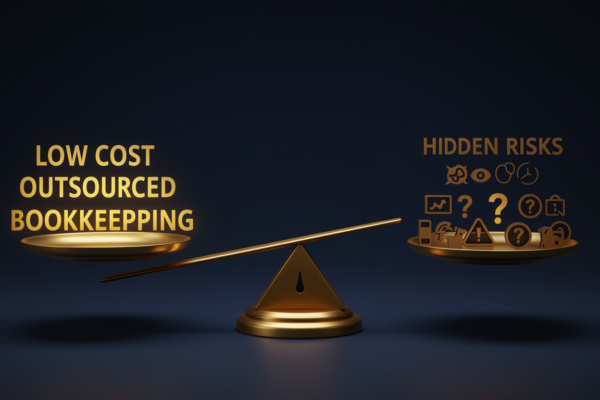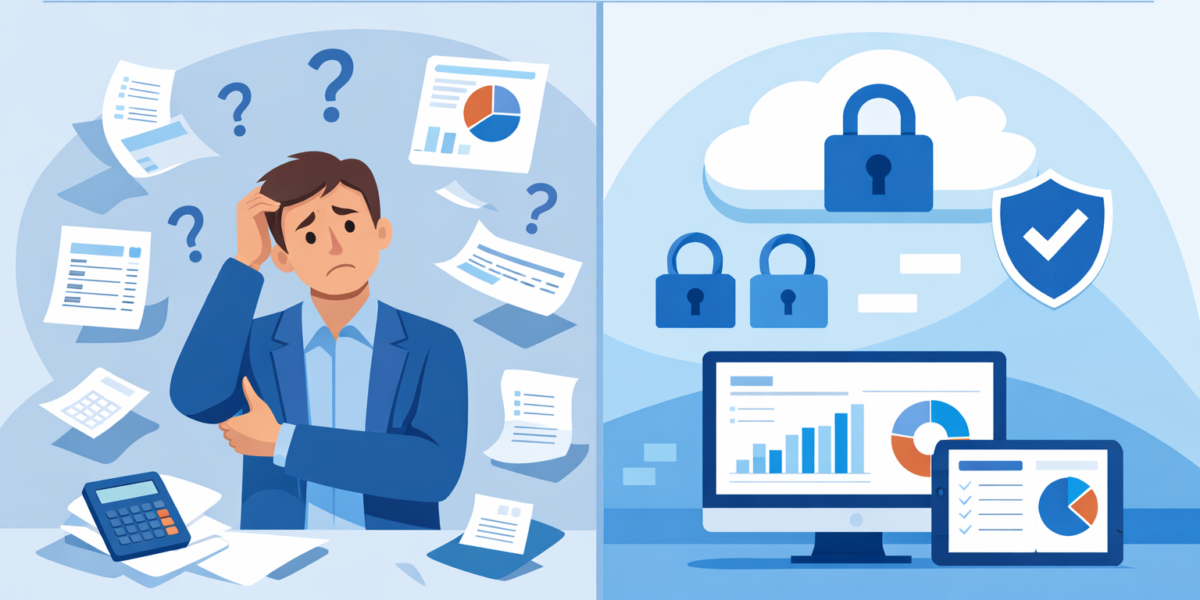
If you’ve ever hesitated before outsourcing bookkeeping — even when you’re stretched thin and turning down new clients — you’re not alone. The number one reason accounting and bookkeeping firm owners hold back isn’t cost. It’s a single question that comes up in every conversation:
“What happens to my clients’ financial data?”
It’s a fair question. Your clients trust you with deeply sensitive information — payroll figures, tax filings, bank accounts, outstanding liabilities. Passing that responsibility to an external team can feel like a significant risk, even when it’s clearly the right operational move.
So let’s not sugarcoat it. This article walks you through exactly how a professional outsourced bookkeeping provider protects your data — from legal contracts to access controls to day-to-day processes. No jargon. Just how it actually works.
Why Data Security Concerns Are Completely Valid
You’re not being paranoid. Data breaches in the financial services sector are real, and the consequences for an accounting firm can be severe: regulatory penalties, loss of client trust, and potential legal liability. The concern is legitimate.
But here’s what most firm owners don’t realise: a well-structured outsourced bookkeeping provider often has stronger data security protocols than an in-house team operating on shared drives, personal laptops, or unmonitored email threads.
The right question isn’t “Is outsourcing risky?” The better question is: “Does this provider have the right safeguards in place — and can they prove it?”
The 4 Layers of Data Security That Actually Matter
When evaluating any outsourced bookkeeping provider — including us — these are the four areas you should examine closely:
Layer 1: Legal Contracts That Protect You Before Work Begins
The first line of defence isn’t technology — it’s legal accountability. Before a single document is shared, a credible provider puts formal agreements in place:
- Non-Disclosure Agreement (NDA) — legally binding confidentiality covering all client data, financial records, and business information
- Data Processing Agreement (DPA) — specifies exactly how your data is stored, used, retained, and deleted at the end of the engagement
- Service agreement with clear liability clauses — accountability in writing if something goes wrong
- No subcontracting without your explicit consent — your data does not get passed to unknown third parties
If a provider doesn’t offer these documents upfront and without prompting, that’s your first red flag.
Layer 2: Access Control — The Most Overlooked Security Measure
Most financial data incidents don’t come from external hackers. They come from internal misuse — someone with access who shouldn’t have it, a shared password that can’t be traced, or a former employee whose credentials were never revoked.
A secure outsourced setup handles this through structured access control:
- Each client is assigned a dedicated team member — not whoever is available that week
- Access is role-based — a bookkeeper handling accounts payable does not have visibility into payroll data they are not responsible for
- Work is performed inside cloud platforms you already control — QuickBooks Online, Xero, Dext — not downloaded to their local machines
- You grant and revoke access yourself — the provider works within your existing software stack, not a system you cannot see into
You remain in control at all times. The outsourced team gets limited, auditable access — exactly as you would set up for a new member of your own staff.
Layer 3: How Your Data Actually Moves — and How It Stays Secure in Transit
File sharing is where most practical security risks live. Emailing PDFs with sensitive client data? That’s a problem. Sharing login credentials over messaging apps? Also a problem. Here is what a professional outsourcing arrangement looks like instead:
- All file exchange happens through encrypted client portals — not email attachments
- Bookkeeping work is done directly inside your existing cloud software — nothing is downloaded or stored locally on their end
- Devices used by the outsourced team have endpoint security: antivirus software, disk encryption, and VPN access where required
- Two-factor authentication (2FA) is required on every shared platform, without exception
Layer 4: Audit Trails — Visibility You Can Actually Verify
You should never have to wonder what happened to your data. A trustworthy outsourcing provider gives you complete visibility through activity logs and audit reporting.
This means you can see exactly who logged into your accounting software, what changes they made, when they worked, and what was accessed or exported. Cloud-based platforms like QuickBooks Online and Xero have this built in.
No black boxes. No “just trust us.” If a provider cannot show you an activity log on request, keep looking.
5 Questions to Ask Any Outsourcing Provider Before You Sign
Use this as your due diligence checklist. A credible provider will have clear, immediate answers to all of these:
- Do you sign an NDA before accessing any client data? (The answer must be yes, offered without prompting.)
- Where does our data actually live? (It should live inside your own software or encrypted portal — not on their servers or local drives.)
- Who specifically has access to our client files? (A named, dedicated team member — not “whoever is on shift.”)
- What happens to our data when the engagement ends? (Access revoked immediately; data deleted from any provider systems within a defined window.)
- Are your team members background-checked? (For any provider handling financial data, the answer must be yes — for every person with client access.)
The Bottom Line
Outsourced bookkeeping is not inherently risky. Poorly structured outsourcing — with no NDAs, no access controls, and no audit trails — is risky. There is a meaningful difference between the two.
A professional provider treats your data with the same seriousness you do. They have built processes around it, because their entire business depends on your trust.
The right question is not “Is outsourcing safe?” It is: “Does this specific provider have the right safeguards in place — and can they show me proof?” If they can, you are in good hands. If they hesitate or get vague, you have your answer.
Want to see how Reliable Bookkeeping handles your data?
We’re happy to walk you through our NDA process, access controls, and data protocols before you commit to anything. Book a free, no-pressure consultation and get straight answers to all of your security questions.
→ Contact us at: hello@reliablebookkeeping.ca